Claude AI vs Kimi AI: How They Compare, and What It Means for Search
Two AI assistants that keep coming up in the same breath lately are Claude and Kimi — one from Anthropic, one from Moonshot AI. If you’re trying to figure out how they differ, which to use, and (if you run a website) whether it matters which one you “optimize for,” here’s a grounded comparison — with the honest caveat that this field changes monthly, so we’ll focus on durable differences rather than benchmark numbers that expire.
The short version
Claude is Anthropic’s assistant, widely used for careful reasoning, writing, and coding, with strong long-context handling. Kimi is Moonshot AI’s assistant, known for very long context, increasingly agentic behavior, and significant reach in the Chinese market. Both are capable, modern, and — crucially for search — both can read external content and reference sources.
For most users, the choice comes down to ecosystem, language and market focus, and the specific task. For most website owners, the more important insight is at the end: you don’t have to choose which one to optimize for.
Head to head
Here’s the durable comparison — the things that don’t flip with every model release:
| Claude | Kimi | |
|---|---|---|
| Made by | Anthropic | Moonshot AI |
| Home market | US / Western ecosystems | China, plus growing global reach |
| Best known for | Reasoning, writing, coding, long context | Very long context, agentic use |
| Language strength | Strong in English (and many others) | Strong in Chinese (and others) |
| Web-capable | Yes, in search-enabled forms | Yes, in search-enabled forms |
| Cites sources | Yes, when it searches the web | Yes, when it searches the web |
Notice the last two rows are identical — and that’s the point that matters most for anyone thinking about visibility.
Where each one tends to shine
Rather than declare a winner (which would be out of date by the next release), it’s more useful to match each to the work it’s commonly reached for:
- Reach for Claude when the task is reasoning-heavy, coding, careful long-form writing, or working through large English-language documents with nuance.
- Reach for Kimi when you’re working in or targeting the Chinese market, or leaning on very long context for large-document tasks.
Both keep improving, and the gaps narrow and shift constantly. The reliable move is to judge either against your actual task — a quick real test on your own use case beats any leaderboard.
The part that matters for your website
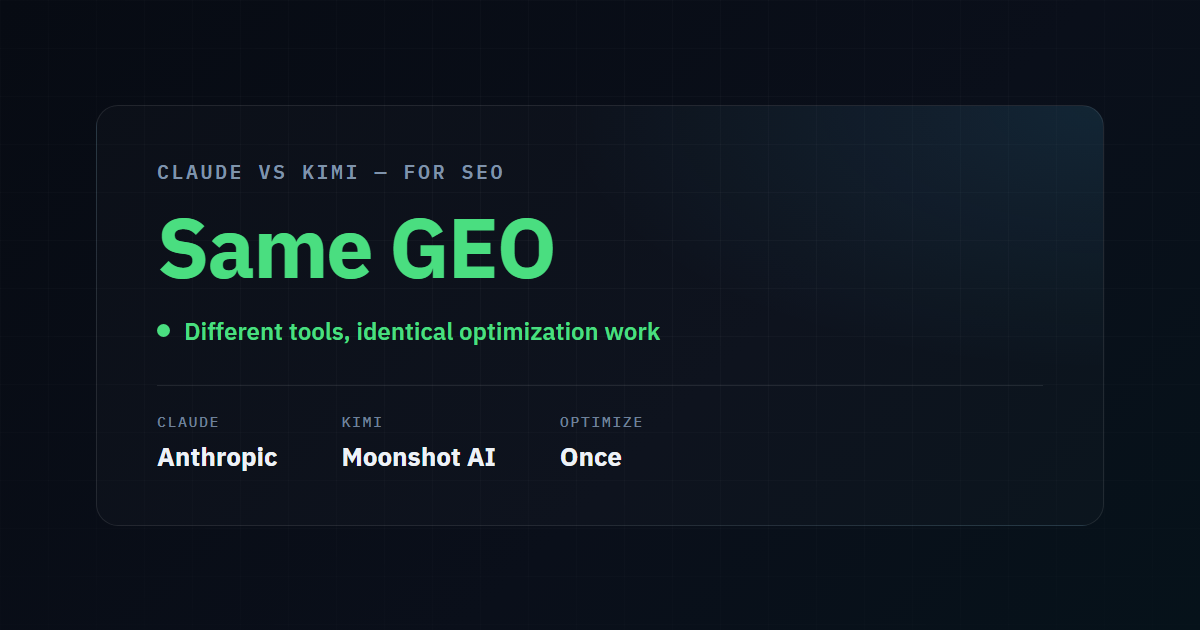
Here’s the reframe that makes the whole “which one?” question mostly irrelevant for SEO: from a content-visibility standpoint, Claude and Kimi want the same thing — and so do ChatGPT and Gemini. Each reads the web, extracts useful passages, and prefers sources it can identify and trust. That shared behavior means one optimization strategy serves all of them.
| To be usable by… | You need… |
|---|---|
| Claude | Extractable passages, trusted entity, crawlable pages |
| Kimi | Extractable passages, trusted entity, crawlable pages |
| ChatGPT / Gemini | Extractable passages, trusted entity, crawlable pages |
It’s the same list every time. This is the core of Generative Engine Optimization (GEO): you optimize for the behavior all assistants share, not for any one of them. We wrote the assistant-specific versions too — how to get cited by Claude and what Kimi AI means for search — and they land on the same three fundamentals:
- Extractable content — clear answers under question-shaped headings, each passage self-contained.
- A trusted, unambiguous entity — consistent naming and structured data so the AI knows who published the claim.
- Technical accessibility — server-rendered, fast, crawlable pages, or the content is invisible before it’s ever judged (see AI SEO for developers).
The honest takeaway
Claude and Kimi are two strong assistants from different makers, tuned for somewhat different ecosystems and tasks — Claude leaning Western and reasoning/coding-heavy, Kimi leaning long-context and China-strong. For choosing a tool, test each on your real work rather than trusting a leaderboard. For your website, stop asking which to optimize for: both reward the same extractable, trustworthy, technically accessible content. Build that once, and you’re ready for Claude, Kimi, and whatever assistant arrives next.
Check whether AI can read your site
Every assistant — Claude, Kimi, and the rest — can only use content it can crawl and read. Our free tool checks whether your pages are server-rendered, fast, and crawlable, the foundation of any AI-visibility strategy.
Want to be ready for every AI assistant?
We engineer content and its technical foundation to be extractable, trustworthy, and accessible to AI — so you’re a candidate to be cited across every engine at once, not optimizing tool by tool.
Published by the Runkexpert Engineering Team. Last updated 2026-07-31.