How to Get Cited by Claude: A Practical GEO Guide for Anthropic's AI
Claude, Anthropic’s AI assistant, increasingly does what search engines do: when you ask it something current or specific, it searches the web, reads pages, and cites the sources it used. That quietly creates a new visibility surface — being one of the sources Claude quotes — and naturally raises the question every marketer eventually asks about every AI: “how do I get cited?” Here’s the honest, practical answer, without the magic-formula promises.
First, how Claude actually uses the web
Claude answers a lot of questions straight from its trained knowledge, no search involved. But for anything time-sensitive, niche, or explicitly asking for current information, it can invoke web search — fetching live pages, extracting the relevant parts, and attributing the sources it relied on. When that happens, your page is competing to be one of those attributed sources.
The important reframe: you are not optimizing to “rank in Claude.” You are optimizing to be extractable and trustworthy enough that an AI reading your page chooses to build its answer from yours. That’s the whole game, and it’s the same game across every AI assistant — which is why this overlaps heavily with getting cited by ChatGPT and the broader Generative Engine Optimization framework.
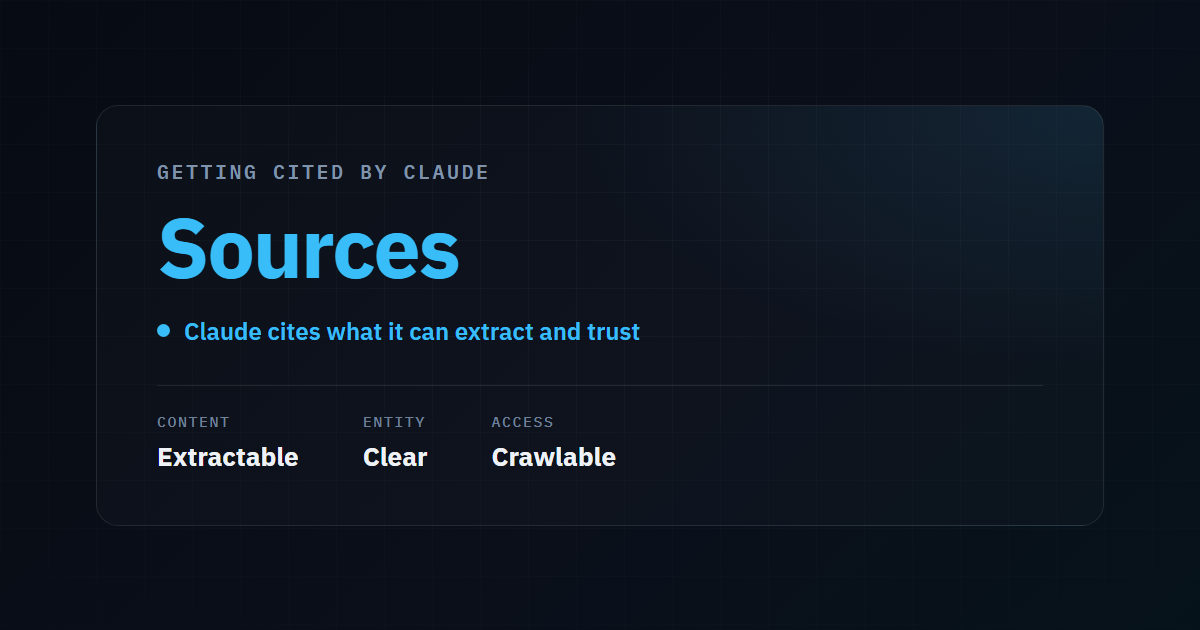
The three things that make content citable
Strip away the hype and citation-worthiness comes down to three properties. A page needs all three:
| Property | What it means | How to earn it |
|---|---|---|
| Extractable | A clean answer can be lifted as a self-contained passage | Lead sections with a direct answer; use question-shaped headings; keep passages standalone |
| Trusted | The AI can confidently identify who published the claim | Consistent entity/name, author and publisher signals, accurate structured data |
| Accessible | The content is actually readable by a crawler | Server-rendered HTML, fast load, no crawl blocks |
Miss any one and the other two can’t save you: a brilliant, trustworthy answer trapped behind client-side JavaScript is invisible; a fast, crawlable page with a vague, buried answer won’t be extracted; a clear, extractable answer from an anonymous, untrustworthy source is a risky citation an AI will skip.
Write for extraction, not just for reading
AI answers are assembled from passages, not whole articles. The single highest-leverage habit is to make each section’s answer liftable on its own:
- Answer first, elaborate second. Open a section with the direct answer, then explain. A model scanning for a response finds it immediately.
- Use headings that mirror real questions. “How does Claude cite sources?” is trivially matchable to a query; “Citation mechanics” is not.
- Keep passages self-contained. If a paragraph only makes sense after three paragraphs above it, it’s hard to extract cleanly.
This is the same discipline behind a good FAQ — which is exactly why FAQ-structured content punches above its weight across AI search, including in Google’s AI Overviews.
Make your entity unmistakable
Claude, like any careful system, prefers to cite sources it can confidently identify. Ambiguity about who is behind a claim makes a page a riskier citation. This is where entity-based SEO and structured data earn their keep:
- A single, consistent Organization identity across your site, linked by a stable schema
@id. - Author and publisher signals on articles, so a real, accountable entity stands behind the content.
- Consistent facts across your pages and structured data, so there are no contradictions for a model to reconcile.
You don’t need to be a household name — you need to be unambiguous and internally consistent.
Don’t neglect the technical floor
An AI cannot cite what it cannot read. This is the part that’s invisible from the marketing side and decisive from the engineering side:
- Server-rendered or static content — the words must be in the HTML response, not assembled in the browser after JavaScript runs.
- Fast, healthy Core Web Vitals — reachability and quality signals correlate with trust.
- No crawl blocks — robots rules, broken paths, or login walls that hide your content also hide it from AI.
If your content only appears after client-side rendering, you’ve made extraction fail before a single word is judged. We cover this developer-side work in AI SEO for developers.
The realistic playbook
There’s no trick, and that’s the point. You improve your odds of being cited by Claude the same way you improve them everywhere: lead with clear answers, structure content into extractable passages, make your entity unmistakable with clean structured data, and keep the technical floor — crawlable, fast, server-rendered — solid. Do that and you’re a strong candidate. Skip it and no tactic will conjure a citation.
Check whether an AI can even read your site
Being cited starts with being crawlable, fast, and clearly structured. Our free tool checks those fundamentals against a live fetch of your site — the floor every AI-citation strategy stands on.
Want to be the source AI quotes?
We engineer content and its technical foundation to be extractable and attributable — clean entity signals, structured data, and fast crawlable pages — so you’re a candidate to be cited by Claude and every other AI assistant, not just indexed.
Published by the Runkexpert Engineering Team. Last updated 2026-07-31.