Does SEO Have a Future if You're Starting in 2026?
Every few years someone declares SEO dead, and 2026 has given the declaration its most convincing costume yet: AI Overviews answering questions before you scroll, ChatGPT and Perplexity summarizing the web without sending a click. If you’re thinking about starting SEO now, the fair question isn’t whether the old SEO is changing — it obviously is — but whether there’s still a future worth investing in. Here’s the honest answer, minus both the doom and the hype.
The Short Answer: Yes — But It’s Shifting
SEO is not dead. People still run billions of searches, and for anything involving a decision, a comparison, or an action, they still click through to real sources. What’s changed is the shape of the results page. The answer increasingly sits at the top, AI-generated, with citations — and the game is shifting from “rank in the ten blue links” to “be the trusted source the answer is built from.”
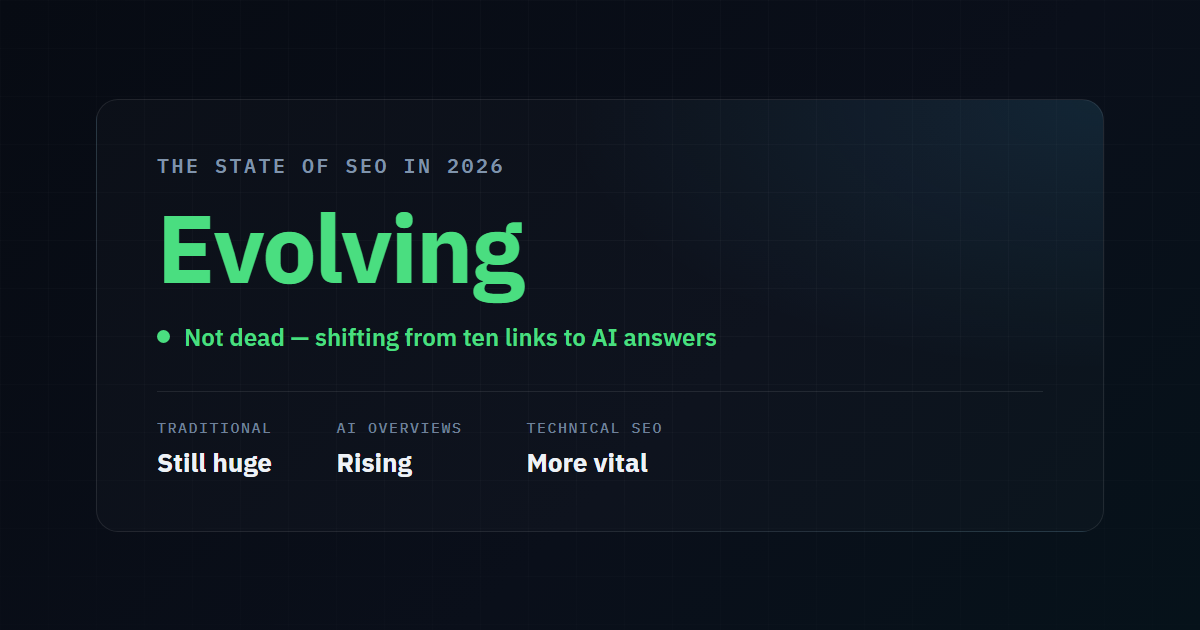
So the future exists — it just rewards different things than it did five years ago. The rest of this article is about which things.
What’s Actually Dying vs. What’s Growing
The confusion comes from lumping “SEO” into one thing. Break it apart and the picture is clear — some tactics are fading, others are more valuable than ever:
| Fading | Growing |
|---|---|
| Ranking thin content for broad head terms | Deep content answering specific intent |
| Keyword-stuffing and exact-match tricks | Entity clarity and topical authority |
| Chasing clicks on simple factual queries | Being cited by AI answers (GEO) |
| Buying links at scale | Earning genuine trust signals |
| ”Set it and forget it” pages | Fast, crawlable, continuously maintained sites |
Notice the pattern: the things dying are the shortcuts. The things growing are the fundamentals done well. That’s actually good news for anyone starting fresh — you get to build on what lasts instead of unlearning tricks that stopped working.
How AI Search Changes the Game
The single biggest shift is that search now has two surfaces to optimize for, not one:
- Traditional results — the familiar ranked links, still enormous in volume, still where most commercial and decision-stage traffic happens.
- AI answers — Google’s AI Overviews, plus ChatGPT and Perplexity, which generate a summary and cite sources. Being one of those cited sources is the new frontier, and it has a name: Generative Engine Optimization (GEO).
Optimizing for the AI surface isn’t a different discipline so much as a reweighting of good SEO — clear, extractable answers, strong entity signals, and technical accessibility. We break the tactics down in how to optimize for AI Overviews and, for the practitioner view, what AI SEO actually is. The key mindset shift: you’re no longer only trying to be ranked; you’re trying to be quoted.
Why the Technical Foundation Matters More, Not Less
Here’s the part that gets missed in every “is SEO dead” debate. As search fragments across traditional and AI surfaces, one thing becomes more important, not less: whether machines can actually read your site.
An AI can’t cite a page it can’t crawl. Google can’t rank content trapped behind slow-loading JavaScript. Both the old surface and the new one depend on the same foundation:
- Crawlable, server-rendered content — the words must be in the HTML, not assembled in the browser.
- Fast Core Web Vitals — LCP, CLS, and INP are ranking signals and trust signals.
- Clean structure and entity clarity — so both Google and AI systems know what your page is and who published it.
This is why the future of SEO tilts toward engineering. The content still has to be good — but good content on a slow, uncrawlable site loses to good content on a fast, accessible one. If you’re weighing where to spend, technical SEO vs marketing SEO is the decision to understand first.
If You’re Starting in 2026: What to Actually Do
Starting fresh is an advantage — no legacy tricks to undo. But the strategy has to match the current reality, not 2018’s. A realistic first-year path:
| Priority | Do this | Not this |
|---|---|---|
| 1. Foundation | Fast, crawlable, server-rendered site | A slow, plugin-heavy build |
| 2. Content | Specific long-tail topics you can rank for | Broad head terms owned by giants |
| 3. Format | Clear answers under question-shaped headings | Wandering, unstructured prose |
| 4. Identity | Consistent entity + structured data | Anonymous, unattributed pages |
| 5. Patience | Compounding over months | Expecting week-one results |
The single most common mistake a new site makes is chasing terms like “on page seo” or “what is seo” — head terms dominated by Ahrefs and Semrush that a new domain cannot rank for. Start narrow. A page targeting “how to fix INP on a WordPress site” will rank and convert long before a page targeting “SEO” ever could.
The Honest Verdict
Does SEO have a future if you’re starting in 2026? Yes — a real one, but it belongs to the people who treat it as it now is: a discipline of genuinely useful content, sitting on a fast and crawlable technical foundation, structured to be extracted by both Google and AI. The shortcuts are gone. The fundamentals are more valuable than ever. If that’s the SEO you’re prepared to do, starting now isn’t too late — it’s a clean start on the version that actually lasts.
See Where Your Site Stands
The future-proof part of SEO — a fast, crawlable, well-structured site — is measurable today. Our free tool checks your Core Web Vitals, crawlability, and on-page signals against a live fetch, so you know your foundation is solid before you build content on top of it.
Want to Start on the Right Foundation?
We build sites engineered for how search actually works in 2026 — fast, crawlable, AI-legible, and structured to rank and be cited. If you’re starting fresh, starting on the right architecture saves you from rebuilding later.
Published by the Runkexpert Engineering Team. Last updated 2026-07-27.